Posted on

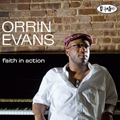
Trioriot reviews ORRIN EVANS TRIO – Faith In Action

trioriot.blogspot.com

Have you heard Orrin Evans play the piano? With a loaded name like that, try Bill Keepnews, it’s easy to be confused but don’t be – you need to hear him, you should hear him, you will hear him. Making jazz albums since the mid nineties, I’m ashamed to say I’ve only just connected to this piano master born in New Jersey in 1976. Faith In Action is a tribute to the great alto player and composer, Bobby Watson whose tunes make up nearly half the CD. Playing here in the company of Nasheet Waits, drums and Luques Curtis, bass, the trio plays in a straight ahead contemporary style with hints of Tyner, Hancock and Monk at the roots. Evans has remained largely under the radar compared to some of his contemporaries in the US scene like Robert Glasper and Taylor Eigsti – maybe because his approach is totally uncompromising, acerbic and without artifice. He swings hard and unrelentingly;Don’t Call Me Wally, Appointment in Milano, but can also turn corners into reflective exploration and meditations on a mood; Matthew’s Song, Love Remains. I love it when the playing descends (or do I mean ascends?) into the avant garde on the fringes of pieces that seem to fray the edges of near oblivion like MAT-Mat andWheel Within a Wheel. This is as good as it gets and when he launches into the Monk-washed, Two Steppin’ With Dawn, you hear the pedigree loud and clear.

For people who like well conceived hard swinging solos that knock at the doors of perception with no hint of commercial compromise, Orrin Evans and the trio is for you. It’s like sailing in a choppy sea in a sleek yacht with an experienced crew who know how to ride the crest of the wave. Highly recommended – the title says it all.
 

Posted on

Peter Margasak’s DownBeat review of Faith in Action…

www.downbeat.com

Orrin Evans

Faith In Action

POSI-TONE 8058

★★★★

“Don’t Call Me Wally,” the three- minute marvel that opens the latest album by the consistently beguiling, elusive pianist Orrin Evans, is a veritable symphony of motion, a wonderfully jagged chunk of Thelonious Monk-like puckishness and rhythmic restless- ness. It also happens to swing like mad. Evans, bassist Luques Curtis, and, especially, drummer Nasheet Waits ferry the piece through end- less shifts, as each player alters melodic patterns and grooves ev- ery couple of bars, forcing their quick-thinking partners to quickly adapt. While the music belongs to New York’s mainstream vanguard, there’s something about it that makes me think of the prankish- ness of Amsterdam’s Misha Men- gelberg and Han Bennink. This opening piece, an Evans original, might be the most perfect and sat- isfying piece of music I’ve heard this year.

Luckily, the rest of the album is almost as good and just as rigorous. This beautifully recorded session captures his muscular, angular side as well as his tender character bet- ter than anything he’s ever done. That he’s able to accomplish this while paying homage to one of his former mentors—saxophonist Bobby Watson, who penned half of the tracks here—indicates the pia- nist’s ability to get inside any piece of music and remake it his own.

—Peter Margasak

Faith In Action: Don’t Call Me Wally; Faith In Ac- tion; Wheel Within A Wheel; Appointment In Milano; Matthews Song; Beatitudes; MAT-Matt; Love Remains; Two Steppin With Dawn; Why Not. (55:36)

Personnel: Orrin Evans, piano; Luques Curtis, bass; Nasheet Waits, drums; Rocky Bryant, drums (3); Gene Jackson, drums (5, 9). ordering info: posi-tone.com


Posted on Leave a comment

Some more coverage for Orrin Evans “Faith in Action”….

by Paul Zetter

Have you heard Orrin Evans play the piano? With a loaded name like that, try Bill Keepnews, it’s easy to be confused but don’t be – you need to hear him, you should hear him, you will hear him. Making jazz albums since the mid nineties, I’m ashamed to say I’ve only just connected to this piano master born in New Jersey in 1976. Faith In Action is a tribute to the great alto player and composer, Bobby Watson whose tunes make up nearly half the CD. Playing here in the company of Nasheet Waits, drums and Luques Curtis, bass, the trio plays in a straight ahead contemporary style with hints of Tyner, Hancock and Monk at the roots. Evans has remained largely under the radar compared to some of his contemporaries in the US scene like Robert Glasper and Taylor Eigsti – maybe because his approach is totally uncompromising, acerbic and without artifice. He swings hard and unrelentingly; Don’t Call Me Wally, Appointment in Milano, but can also turn corners into reflective exploration and meditations on a mood; Matthew’s Song, Love Remains. I love it when the playing descends (or do I mean ascends?) into the avant garde on the fringes of pieces that seem to fray the edges of near oblivion like MAT-Mat and Wheel Within a Wheel. This is as good as it gets and when he launches into the Monk-washed, Two Steppin’ With Dawn, you hear the pedigree loud and clear.

For people who like well conceived hard swinging solos that knock at the doors of perception with no hint of commercial compromise, Orrin Evans and the trio is for you. It’s like sailing in a choppy sea in a sleek yacht with an experienced crew who know how to ride the crest of the wave. Highly recommended – the title says it all.
Posted on Leave a comment

Here’s a new review for Jacam Manricks “Trigonometry” by AAJ contributor Bruce Lindsay….


by Bruce Lindsay

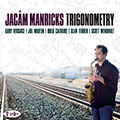
Jacám Manricks is a rich-toned saxophonist and composer with a growing body of original tunes—Trigonometry appears hot on the heels of the self-released Labyrinth (Manricks Music Records, 2009). The New York based musician has allied himself to a strong ensemble of players who happily take on the challenge of Manricks’ compositions and invest them with some terrifically enthusiastic playing. The result is a bop-inspired album that can readily surprise and delight.

The album begins emphatically on “Trigonometry” with the drums of Obed Calvaire, followed soon after by Gary Versace on piano and Joe Martin on bass. It’s a fitting opening as these three players are uniformly excellent throughout—Calvaire in particular displays invention but also a great ability to interact with the front line.

“Cluster Funk” is indeed funky, with Versace’s chunky piano chords and tight ensemble playing from the horn section, including trombonist Alan Ferber, driving the tune along with suitable urgency into a strong, slightly frenetic, solo from guest trumpeter Scott Wendholt. In contrast, “Mood Swing” is a more contemplative and slightly mysterious tune that features atmospheric solos from Versace and Manricks while “Labyrinth” finds the album’s core quartet delivering a more complex tune with some inventive variations in rhythm and tempo. “Micro Gravity” has the most improvised feel of any of the tunes here—a flowing, reflective, piece that showcases Manricks and the rhythm section at their most innovative.

Eric Dolphy’s “Miss Ann” is the album’s only non-original tune. Manricks, Martin and Calvaire show their strength as a trio on this tune—Manricks’ sax playing is exceptional here, as is the interplay between Manricks and Calvaire which is held together by Martin’s rock solid bass before he gets the chance to take his own solo. It’s an excellent choice for the album—Manricks’ fine arrangement is beautifully played and blends well with his own original compositions. Trigonometry establishes Manricks as a writer and player of note.

Track listing: Trigonometry; Cluster Funk; Slippery; Nucleus; Miss Ann; Sketch; Mood Swing; Labyrinth; Combat; Micro Gravity.

Personnel: Jacám Manricks: saxophones; Gary Versace: piano; Joe Martin: bass; Obed Calvaire: drums; Alan Ferber: trombone; Scott Wendholt: trumpet.

Posted on Leave a comment

Another compelling writeup for Sarah Manning “Dandelion Clock”….

by Tim Niland
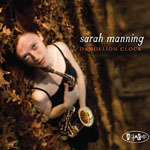
Studying with jazz iconoclasts like Jackie McLean and Yusef Lateef has given Sarah Manning the confidence to develop her own conception of jazz music. Employing a tart and immediate tone on alto saxophone and supported by pianist Art Hirahara, bassist Linda Oh and drummer Kyle Struve, she explores eleven compositions, both standards and originals. “The Peacocks” opens the album with pinched acerbic alto saxophone and lush piano. Manning’s dark toned alto floats over an atmospheric, rippling backdrop to good effect. She is very successful with the ballad “Habersham Street,” employing a yearning tone over emotional, nearly romantic piano support. An impressive unaccompanied alto section allows her to fly solo with dramatic and effective results. “I Tell Time by the Dandelion Clock” broods moodily before picking up to an insistent trio section and pinched alto saxophone solo. “The Owls (Are on the March)” is the centerpiece of the album, opening spare and spacious and then building suite-like through sections of march drumming with saxophone and an expansive piano – saxophone duet. “Phoenix Song” builds the pace to a sing-song feel and solid medium tempo quartet swing. After a rippling piano trio feature, Manning’s strong saxophone returns in a dialogue trading nimble phrases with the drummer Struve. This was a very solid album of modern mainstream jazz. The most impressive thing for me was the strong and piercing tone that Sarah Manning has developed on her instrument, she is well on her way to the holy grail that musicians strive for, “finding their own voice.” Linda Oh (who released a great album of her own last year) is excellent as well with rock solid accompaniment and inventive soloing.

Posted on Leave a comment

Sarah Manning “Dandelion Clock” gets a nice mention in “The Best Jazz of (Early) 2010” article on NPRs “A Blog Supreme”….

Patrick Jarenwattananon
Over at NPR Music’s Take Five listening series, we’ve posted our team roundup of The Best New Jazz Of 2010 (So Far). Nick Francis of Jazz24, Shaunna Morrison Machosky of WDUQ and Josh Jackson of WBGO all chimed in, and there are picks from staff listeners me and Lars Gotrich. We invite you to hear tracks from Pat Metheny’s Orchestrion, Geri Allen’s solo record, Brad Mehldau’s symphonic double-CD set, the trio of Kris Davis/Ingrid Laubrock/Tyshawn Sorey and Stephan Crump’s Rosetta Trio of bass and two guitars.

All are worthy choices to be sure. But what do you think? What have we missed? What are your favorite jazz records of 2010 so far? Let us know: leave us a comment, either here or on the Take Five page. [Take Five: A Weekly Jazz Sampler: The Best New Jazz Of 2010 (So Far)]

Personally speaking, if I were making a top five list for 2010 so far, I think it might include some of these following records — I’ll limit myself to ten:

* Geri Allen and Timeline, Live (Motema): Part two of Allen’s dual releases in 2010 features a new quartet: long-time bassist Kenny Davis, new drummer Kassa Overall and tap-dance percussionist Maurice Chestnut. It’s no gimmick: this here is a real band, swirling in rhythm.
* John Ellis and Double-Wide, Puppet Mischief (ObliqSound): Fun, tuneful and a little demented. All in a good way. Plus, when does John Ellis’ saxophone not brighten your day?
* Jason Moran, Ten (Blue Note): The Bandwagon trio has been together 10 years now. Ten years! There was no agenda for this recorded document other than to document. There’s a lot to document. Again, hear it all here.
* Steve Coleman and Five Elements, Harvesting Semblances And Affinities (Pi Recordings): Music that works on the “jazz nerds” level, but those who don’t naturally think in irregular meters may find themselves instinctually lurching along. More thoughts on this soon.
* Scott DuBois, Black Hawk Dance (Sunnyside): A sleeper pick goes to a record that’s both in and out, and altogether lovely.
* Chris Lightcap’s Bigmouth, Deluxe (Clean Feed): Lightcap, Tony Malaby, Chris Cheek, Craig Taborn, Gerald Cleaver and spots from Andrew D’Angelo: the lineup reads like an all-star game of musician’s musicians, except none of them, least of all the composer, are slacking.
* Matthew Shipp, 4D (Thirsty Ear): This is shaping up to be quite a year for spell-inducing, half-abstracted solo piano.
* Fight The Big Bull feat. Steven Bernstein, All Is Gladness In The Kingdom (Clean Feed): A post-modern jazz band with plenty of good ideas and a love for anything you could possibly call Southern music.
* Mike Reed’s People, Places and Things, Stories and Negotiations (482 Music): New-school Chicago progressive improvisers meet old-school Chicago veterans, playing both old and new tunes. Their fire and swing is unbeholden to school.
* Sarah Manning, Dandelion Clock (Posi-Tone): I just read that Manning’s day job is in real estate. Someone needs to get her more gigs so folks can hear her piercing saxophone tone live more often.

What else? Emilio Solla? Lionel Loueke? The Claudia Quintet? Abdullah Ibrahim’s big band recording? We could go on …

Posted on Leave a comment

A nice write-up by AAJ contributor Mark Corroto for our latest release “Trigonometry” by saxophonist/composer Jacam Manricks….

By Mark Corroto

There is a snap to the music of saxophonist Jacám Manricks’ music that calls to mind the invention of bebop with it’s fidgety energy. Without looking backwards, this recording re-invents that atmosphere of bop animation.

After self-releasing Labyrinth (2009), he returns with a stellar cast of players that includes his quartet of Gary Versace (piano), Joe Martin (bass), and Obed Calvaire (drums). Sitting in as guests on several tracks are trombonist Alan Ferber and Scott Wendholt on trumpet.

Manricks’ alto recalls that of Greg Osby and the title Trigonometry explains the sometimes precise intersections his compositions meet. This is snappy and succinct music with particular direction as demonstrated on the title track. The band negotiates the tunes, but not without a certain swing that pleases. Manricks enjoys a rapport with pianist Versace that is both of like-mindedness and foil. They match wits on the tight and twisty tune “Slippery” and butt heads on the skittery track “Sketch” that jumps around in a Thelonious Monk-like fashion.

When the quartet is joined by guests Wendholt and Ferber, Manricks’ compositions expand into broad harmonies. The overtly smelly “Cluster Funk” recalls some 1960’s chittlin’ circuit sound updated to a Brooklyn hipsters chant.

The only track not composed by Manricks is Eric Dolphy’s “Miss Ann” which he plays in a bass/drums trio. Shaved to the bone, he displays his flawless technique addressing the track with a fluid manner.

Track listing: Trigonometry; Cluster Funk; Slippery; Nucleus; Miss Ann; Sketch; Mood Swing; Labyrinth; Combat; Micro Gravity.

Personnel: Jacám Manricks: alto saxophone; Gary Versace: piano; Joe Martin: bass; Alan Ferber: trombone; Scott Wendholt: trumpet; Obed Calvaire: drums.

Posted on

Sarah Manning – Dandelion Clock (Posi-Tone, 2010)

jazzandblues.blogspot.com

Studying with jazz iconoclasts like Jackie McLean and Yusef Lateef has given Sarah Manning the confidence to develop her own conception of jazz music. Employing a tart and immediate tone on alto saxophone and supported by pianist Art Hirahara, bassist Linda Oh and drummer Kyle Struve, she explores eleven compositions, both standards and originals. “The Peacocks” opens the album with pinched acerbic alto saxophone and lush piano. Manning’s dark toned alto floats over an atmospheric, rippling backdrop to good effect. She is very successful with the ballad “Habersham Street,” employing a yearning tone over emotional, nearly romantic piano support. An impressive unaccompanied alto section allows her to fly solo with dramatic and effective results. “I Tell Time by the Dandelion Clock” broods moodily before picking up to an insistent trio section and pinched alto saxophone solo. “The Owls (Are on the March)” is the centerpiece of the album, opening spare and spacious and then building suite-like through sections of march drumming with saxophone and an expansive piano – saxophone duet. “Phoenix Song” builds the pace to a sing-song feel and solid medium tempo quartet swing. After a rippling piano trio feature, Manning’s strong saxophone returns in a dialogue trading nimble phrases with the drummer Struve. This was a very solid album of modern mainstream jazz. The most impressive thing for me was the strong and piercing tone that Sarah Manning has developed on her instrument, she is well on her way to the holy grail that musicians strive for, “finding their own voice.” Linda Oh (who released a great albumof her own last year) is excellent as well with rock solid accompaniment and inventive soloing.


Posted on

jazzreview.com write-up for Faith in Action…

www.jazzreview.com

CD Title: Faith in Action

Year: 2010

Record Label: Posi-Tone Records

Style: Straight-Ahead / Classic

Musicians: Orrin Evans (piano), Luques Curtis (bass), Nasheet Waits (drums), Rocky Bryant (drums on one track), Gene Jackson (drums on two tracks)

Review:This is an entertaining and satisfying set by an unusually good piano trio. Veteran Orrin Evans has played for years with Bobby Watson’s group. Here he does five of the saxophonist’s tunes, four of his own and “Why Not” by D. Warren. The moods range widely—from the tropical lushness of Watson’s “Love Remains” to the Monkish “Two Steppin with Dawn,” best of the Evans originals.

Evans is seldom out of the spotlight, but the trio is tightly integrated. Only 27, bassist Luques Curtis is the solid foundation. Nasheet Waits, a drummer who has begun to attract a lot of knowledgeable attention, is more assertive but always in a good cause. Unlike modern drummers who drop odd bombs and solo from the beginning to the end of an arrangement, the active Waits is more partner than competitor. His colorful additions echo the rhythm of Evans’s melodic line or intensify changes in the trio’s dynamics and groove.

The three-way interplay is particularly rich on “Wheel Within a Wheel” and “Matthews Song;” the arrangements display a bit of the intricate sophistication of classical music without losing the swinging freedom of jazz.

A hard-driving version of Watson’s “Appointment in Milano” is another winner. It features Waits at his most aggressive, but Evans and Curtis hold their own, even when the mood is at its wildest. In a good example of album pacing, “Beatitudes” follows. The only piano solo, it is introspective and mildly abstract.

Evans cites a raft of influences, famous and obscure, many of them non-pianists. He has incorporated bits of each in a versatile style of his own, demonstrated here in one of the year’s best trio outings. It’s not easy to attract attention amidst the swarm of veterans and terrific young players like Jason Moran, Vijay Iyer and Luis Perdomo, but this album makes a strong case for adding Orrin Evans to your list.

Recommended.


Posted on Leave a comment

Raul d’Gama Rose’s review of Dandelion Clock from AAJ

Dandelion Clock
Sarah Manning | Posi-Tone Records (2010)

By Raul d’Gama Rose

It takes a long time for the delightful shock of first hearing Sarah Manning’s emphatic, almost blasé, voice—rich, tunefully accented and almost bronzed, as full as a sudden blast of sunshine. The first sounds of her alto saxophone are so indelibly burned in the memory that virtually everything else becomes a blur except undulating glissandos of her melodic outbursts that often end in shy tremolos. The brilliant alto saxophonist waxes eloquent in a forthright, exacting voice, with fluid and bright lines like operatic arias. She tempers them with the concrete imagery of the pastoral, melding with the elasticity of the urbane. The dissonance that arises when the two rub shoulders is palpable, yet ever so magical. Hers is a singular voice, although it sometimes recalls the sharp altissimo grace of Johnny Hodges.

On Dandelion Clock, Manning brings all her aquiline tones and textures to bear on seven unique compositions and two classic tracks that she makes her own, from the first notes. She is ably assisted by pianist Art Hirahara, an excellent foil with his tempered notes and fluid style. But then bassist Linda Oh adds her sharply stabbing notes and Kyle Struve is entrancing with his dancing, melodic manner in which he coaxes sounds from the delicately tuned drums. Much has been written about the unique imprint of Manning’s compositions. Like her alto playing, she writes like no one else. And her narratives are perfectly suited to her playing. She lets the topography of each song define the story. The crepuscular “The Owls (Are On The March)” and almost gothic “Phoenix Song” are dark nocturnes, echoing with a strange blend of the horror of post dusk hours and an almost mystical union with the sound of the night. Her saxophone is beyond evocative, in an almost prowling way.

“Through The Keyhole” comes alive with imagery that appears through sharply squeezed notes which flow abundantly. “Marble,” “Habersham Street” and “Crossing, Waiting” unravel like water colors that remain wet and almost amorphous. Only “I Tell the Time by the Dandelion Clock” suggests a slanted story with its fantastic images and melodic dalliances. Among the equally memorable moments on the album are the brilliant renderings of, first, Jimmy Rowles’ “The Peacocks,” a beautiful song full of meandering glissandos and seemingly punctuated by fatal cries at its end. Then there is Michel Legrand’s famous tune from the film The Thomas Crown Affair, “The Windmills of Your Mind.” The supercharged energy of the song is built up by a lengthy introduction with tremulous excitement, so that when the melody is first sounded, the anticipation makes it all the more breathtaking. And this is not the least because of Manning’s plaintive reading.

It may be time to explore further the breathtaking world of Sarah Manning. Dandelion Clock may be only the beginning.

Track listing: The Peacocks; Marble; Habersham Street; I Tell the Time by the Dandelion Clock; Crossing, Waiting; The Owls (Are On The March); Through the Keyhole; Phoenix Song; The Windmills of Your Mind.

Personnel: Sarah Manning: alto saxophone; Art Hirahara: piano; Linda Oh: bass; Kyle Struve: drums.