ejazznews.com
ejazznews.com
www.philly.com
Orrin Evans and the Captain Black Big Band */Captain Black Big Band /(Posi-Tone Records ***1/2) Pianist Orrin Evans embraces a larger-than-usual cast on this big-band recording. The seven pieces - one is recorded at Chris' Jazz Cafe in Philadelphia, the rest at the Jazz Gallery in New York - are hard-blowing, tumultuous affairs that could come from the Art Blakey playbook, albeit with some updating. Evans, a composer, arranger, and even a promoter, pulls players from Philly and New York for a CD full of warm horns and slashing solos. Composers/arrangers Todd Bashore and Todd Marcus offer up compositions and arrangements along with Evans, who keeps the reliably combustible proceedings on track. While not always pretty, it is the real deal. Tenor saxophonist Ralph Bowen and altoists Rob Landham and Jaleel Shaw are some of the folks who light up this disc. *- Karl Stark*
Posted by S. Victor Aaron
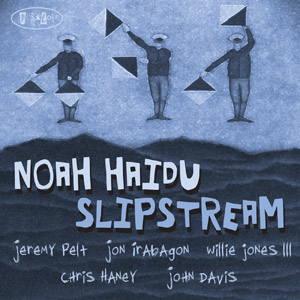
Posi-Tone Records, the label that has done more than anyone else lately in putting out records by the brightest new talent in mainstream and modern jazz, introduced the pianist and composer Noah Haidu to the world last week. Slipstream went on sale March 22, a debut that doesn’t present mere potential, but an accomplished jazz ace making hard-bop in an accomplished manner.
JARED GOLD/All Wrapped Up: Wide ranging organ date that is all original but sounds like any number of Miles/Prestige era dates. Kicking it off like it’s a classic inspired outing, the moves move all over the board from mainstream to uber progressive and you can be sure Gold is moving the organ forward throughout—and beyond. Aggressive and upbeat, this is the sound of what it is to be a contemporary jazzbo right now. Well done.
8080
Orrin Evans’s Captain Black Big Band
Some of the same energy of the Sanabria record lives in “Captain Black Big Band” (Posi-Tone), the first album from a new large ensemble led by the pianist Orrin Evans. Recorded at spots around Philadelphia and New York City over the past year, it is deep in the tradition of African-American East Coast jazz since the mid-’60s, percussive, punching and hard swinging; it might make you think of big bands led by Charles Tolliver, Charles Mingus and Clifford Jordan. And with its multiple composers and even multiple pianists, it’s got range. (Mr. Evans conducts as well; when he does, others take his keyboard bench.) There are many soloists worth mentioning here — the trumpeter Walter White, the drummer Anwar Marshall, the pianist Neil Podgurski. But the alto saxophonist Jaleel Shaw outdoes them all with his performance at the end of Mr. Evans’s alternately peaceful and baleful piece “Jena 6.” It is a prolonged and controlled fury, definitely one of the best improvisations I’ve heard this year.
outsideinsideout.wordpress.com
Orrin Evans: Captain Black Big Band (Posi-Tone PR 8078)
There’s nothing like hearing a big band charging ahead at full throttle, which is what you get with Orrin Evans and the Captain Black Big Band. The tunes, arrangements and style is a contemporary and updated take on the traditional, swinging, high powered big band; it’s nothing like recent work by Maria Schneider or Darcy James Argue. The disc was recorded on three different occasions: two consecutive nights at The Jazz Gallery in NYC in April of ’10 with the opening tune recorded in Philadelphia at Chris’ Jazz Cafe in February of that year. Due to the different venues and the fact there were several weeks in between recordings the personnel varies, and as such there are a lot of folks who contributed to the album, some you’ve probably heard of such as saxophonists Tia Fuller, Jaleel Shaw and Wayne Escoffery, as well as those who I am less familiar with, but who are no less killing. Soloists are listed, but other than that it’s difficult to tell who played on what night – but really it doesn’t matter because every track is consistently engaging and well executed. The band’s arrangements, which strike a perfect balance between solos and ensemble playing, are by Ralph Peterson, Gianluca Renzi, Todd Bashore, Todd Marcus and Orrin Evans. The section playing and rhythm section is tight throughout. ”Art of War” opens up the album, with altoman Rob Landham whipping the crowd into a frenzy with his altissimo acrobatics. Renzi’s “Here’s the Captain” features an opening piano solo by Evans before the horn sections jump in and play against each other with counter statements, it’s an updated take on the arranging methods of the early Basie units – but don’t take that to mean this is a throwback outfit. Victor North’s exploratory tenor solo lays perfectly over the Afro-Cuban-esque groove and is stoked nicely by the horn backgrounds near the end of his solo. Evans’ solo, backed by a medium up swing ride cymbal pattern from Gene Jackson, builds in intensity and tension, as he lays down right hand single note runs with highly syncopated and accented left hand chords. Evans’ “Easy Now,” arranged by Todd Marcus, throws down some serious brass bombast – the bass bone and bari sax players are straight nasty here. Lead trumpeters Brian Kilpatrick and Walter White, who damn near blows the house down on “Big Jimmy,” are bad bad men throughout. Jaleel Shaw’s alto solo on the album’s closer “Jena 6,” and which takes up the track’s final seven minutes, is the record’s highest point for me (but I’m biased because I’m a saxophonist). He runs the gamut, from free time probing statements that eventually settle into scorching fast bebop runs spurred on by the rhythm section and the monster horn background chords, to growled screams, to a climaxing solo cadenza that suggests an urgency and need to get everything he can out of his horn at that particular moment. Evans’ Captain Black Big Band is one of the most fun, energetic, swinging and compelling big band records I’ve heard in a while. If you can’t see them live (which I’m sure I won’t be able to do, as I live outside Kansas City) get the record.
Last summer, jazz saxophonist Doug Webb released an entertainingly trad album titled Midnight. This new one, from the same session, is called Renovations. If we’re in luck, maybe we’ll live to see them reissued together as Midnight Renovations. Intriguing title, huh?
This one is a lot more upbeat, occasionally pretty intense. Buckle your seatbelt – bet you’ve never heard as energetic a version of Satin Doll as the one that has the band jumping out of their socks as animatedly as they do for seven minutes and change here. Besides Webb on tenor, there’s Joe Bagg on piano,Stanley Clarke on upright bass and Gerry Gibbs on drums. Larry Goldings’ casually rippling, summery piano provides an apt backdrop for the languid soprano sax lines on a swaying midtempo verison of Then I’ll Be Tired of You – and his organ background comes through fluid and concise, a long solo taking everything up to a crescendo that holds back just thisshort of joyous. An especially amped version Vernon Duke’s hit I Can’t Get Started, from the long-forgotten film Follies of 1936, has Webb charging hard alongside Mahesh Balasooriya’s express-train piano.
With Goldings manning the throttle again, a tensely swinging I’ve Never Been in Love Before contrasts with Webb’s long, comfortable runway landing, and then brings in some genial blues with the piano. They take Nat Cole’s You’ve Changed doublespeed at just the right random moment; Gershwin’s They Can’t Take That Away from Me, the bluesiest tune here, is also unsurprisingly the most rustic.
Toots Thielemans’ Bluesette is reincarnated, stripped down to what’s basically a rapidfire two-chord jam, Webb’s soprano sax taking a clarinet-like tone, Balasooriya spinning off some wildfire cascades to Webb who takes them even higher: it’s a triumphant pinnacle in an unlikely setting, more than hinting at how much further outside they might be capable of going if they went on longer. The album’s closing cut, Henry Mancini’s Slow Hot Wind – now there’s a title for the moment, huh? – is sort of the mirror image of that, slowly pulsing and sultry, with a geniunely fluid, relaxed solo by Clarke where he doesn’t overvibrato it, Webb’s tenor pushing the caravan along with a stream of eighth notes, Goldings’ dynamics refusing to let the suspense go too far one way or another, Webb finally joining him and they tumble into the vortex. It’s another welcome out-of-control moment – Lisa Simpson, eat your heart out. If you’re wondering what that’s all about, Webb voices her sax parts on the tv show. This one’s out now on Posi-tone.
outsideinsideout.wordpress.com
Thanks to the good folks at Posi-Tone records I’ve been receiving their new releases after reviewing Ralph Bowen’s latest in the April issue of Downbeat. Except for the work done by saxophonist Sean Nowell for the label (who happens to be a friend of a friend and a super nice guy) I was pretty unfamiliar with the label’s output, so it’s good to hear the additions the label is making. Based on what I’ve heard recently Posi-Tone is consistently putting out contemporary records which are firmly based in the post-bop tradition. These albums, all recorded by serious and mature players, some of whom aren’t big names (although based on what I’ve heard they deserve to be), swing hard, display drive and intensity, and are all entertaining and rewarding. Here’s the first part of a three part review of new records from Posi-Tone.
Benjamin Drazen: Inner Flights (Posi-Tone PR8076)
Benjamin Drazen, who primarily wields alto on Inner Flights, has synthesized several alto styles and approaches to create an individual voice. His alto tone is both hefty and lithe, able to deftly fly through the changes or take a more heavy, meditative approach. At times I hear Jackie McLean’s bite (but none of McLean’s intonation problems), Kenny Garrett’s swagger and slight growl, and a melodicism, sensitivity and sweetness (especially on “Polka Dots and Moonbeams”) that recalls Cannonball and several others. But, despite these influences Drazen sounds like himself. Except for George Gershwin’s “This is New” and “Polka Dots” the album’s compositions are all Drazen’s. “Monkish,” which features a lovely solo stride piano intro by Jon Davis, is just that, Monkish. It settles into a two-beat for a full statement of the head and then moves to a straight ahead medium swing for the solos. I’m a little less taken with “Prayer for Brothers Gone By,” which is a little too similar to Coltrane’s “After the Rain” in mood and style (arco bass, free time, cascading piano runs and lots of cymbal work). It’s done well, but I keep wanting to hear Coltrane’s tune. “Neeney’s Waltz” features a lovely alto and piano ballad introduction before moving to the easy medium waltz. Inner Flights is a solid disc by a young saxophonist who I’d love to hear more from in the future.
Slipstream – Noah Haidu (Posi-Tone Records) -The Los Angeles, CA-based Posi-Tone keeps finding new artists deserving of our attention. Haidu, a Virginia native and graduate of Rutgers University, is no exception. His debut session as a leader features the fine front line ofJeremy Pelt (trumpet) and Jon Irabagon (alto sax) with the solid rhythm section of Chris Haney (acoustic bass) and drummersJohn Davis or Willie Jones III (on 3 tracks).
The blend of Pelt and Irabagon, 2 players who know the history of their respective instruments vis a vis jazz, makes for intriguing music. The opening track, “Soulstep“, has the feel of early 1960s Horace Silver with its funky rhythms and “sweet” solos. “Where We Are Right Now” moves in similar fashion but the piece feels somewhat more exploratory – one hears the change in the shifting tempi (kudos to John Davis for really pushing the band.) The pianist really dances over the active rhythm section, spurring on the bassist and drummer to a higher intensity. Irabagon, who’s best known for his work in Mostly Other People Do the Killing as well as being the winner of the 2009 Thelonious Monk Competition, sinks his teeth into a passionate solo. Pelt, who has developed into a masterful player, takes a lovely solo on “Take Your Time“, a ballad on which Haidu’s solo builds quietly but firmly into a soulful expression. Pelt’s bluesy solo on “The Trouble Makers” gives the piece a Jazz Messengers feel, a la the ensemble featuring Lee Morgan and Wayne Shorter. “Break Tune” blends the influences of Monk, Herbie Hancock and Geri Allen into a most funky concoction, the trumpet and saxophone trading phrases over Davis’s “fatback” drumming.
The program also includes several trio tracks (sans sax and trumpet) – there is the fast-paced romp through Cole Porter’s “Just One Of Those Things” and a sweet ballad titled “Float.” On the latter track, bassist Haney supplies fine counterpoint to the pianist’s thoughtful solo work. That’s one of Haidu’s strength in that he does not try to blow the listener away with prodigious technique – his solos unwind gradually, growing out from the melody or harmonic patterns.
“Slipstream” won’t blow you away with fiery solos or breath-taking rhythms but impresses with its subtle variations on classic sounds, the short but pithy solos and the classy rhythm section work. Noah Haidu can certainly play and, in his quickly maturing compositional style, he creates pleasing musical playgrounds for his band. For more information, go to www.noahhaidu.com.
Here’s the opening track of the CD, courtesy of Posi-Tone Records and IODA Promonet:
Soulstep (mp3)
Posted by Nick DeRiso
by Nick DeRiso
Turns out, it actually does mean a thing, even if it ain’t got that swing.
For something like 80 years now, that old Duke Ellington cliche worked as the clarion call of big band music, but its mantra has also become its curse. Subsequent generations moved on to genres with more complexity, a challenge that Orrin Evans‘ new Captain Black Big Band accepts, and then inhabits.
In fact, the album defiantly shucks off the bow-tied fox-trotting boilerplate of old. Nowhere is that more true than this tune, as Evans and Co. musically recall a racially charged 2007 incident at a high school in this sleepy Louisiana village that eventually led to consumptive demonstrations of emotion, and national headlines. Appropriately, “Jena 6″ transforms, in the space of a few moments, from this gospel-tinged solo into an unhinged outpouring of seething rage.
Composer and arranger Evans, who also calls his group the Captain Black Big Band, opens the tune with a stoic piano interlude by Neal Podgurski, recalling those familiar black-and-white newsreel struggles at lunch counters, bus stops and on the other end of fire hoses. But he isn’t about to settle for the staid heroism of that image, even if that’s what’s so thoroughly expected. When a funereal smattering of horns finally joins in, the crowd at New York City’s Jazz Gallery seems tempted to applaud, only to pause and think better of it. There is this catharsis in those devastating wails — but not the joyous kind. As the larger group joins in, “Jena 6″ takes on a swaying, atmospheric grief, and you’re reminded of how this whole thing started.
Six African-American teenagers were initially charged in adult court with attempted murder and conspiracy charges in the beating of a white classmate in Jena, Louisiana, an incident that followed months of racial tensions in the town of about 3,000 people. Subsequently called the Jena 6, their case drew national attention from civil rights groups that said the charges were excessive, and more than 15,000 people turned out for a September 2007 rally on the teens’ behalf. The charges were eventually reduced, but not before the town became a symbol of the issues that linger between blacks and whites.
It’s a complex, unresolved, punishing memory, the kind that leaves a residue of flammability. The full measure of that is revealed as altoist Jaleel Shaw steps forward on this, the closing track for Captain Black Big Band, just out on Posi-Tone Records. At first, he’s insular and thought provoking, then he’s charging forward — echoing the turbulent emotions that welled up toward an eventual outburst. Evan’s group provides striking symphonic blasts, like gun fire, as Shaw delves deeper. By the end of his excursion, more than five minutes later, Shaw has descended past a blur of fear, and into a singing fury.
The song finds, in its conclusion, something that’s towering, nearly apocolyptic, and appropriately so. Evans and Co. don’t so much pull Shaw back into a concluding musical signature — something so blandly typical of jazz music in general, and of big-band music specifically — as launch him into a searing, otherworldly, nearly out of control series of aggressive, non-linear ruminations. He sounds very much like a clinched fist.
“Jena 6,” difficult to listen to but yet reflective of the disquiet surrounding that event, is perfectly unsettling. And a perfect example of what big band music can still be.