Posted on

Something Else! Interview: Orrin Evans

somethingelsereviews.com

Something Else! Interview: Orrin Evans, jazz pianist, composer and bandleader

Posted by Nick DeRiso

Orrin Evans arrived amidst a wave of new jazz performers in the early 1990s. Unlike many of those young lions, however, he managed to bob up from that era’s ultimately empty retro-conservatism. “A lot of those guys, quite frankly,” Orrin says, “just gave too much of a f—. And I never did.” By that, Evans means he never cared that much about being careful, for convention. It hasn’t sold him more records, nor made him a bigger star. Yet, even today, his passion for the work remains unquestioned. And, it seems, Evans is finally getting his due.

SomethingElseReviews.com caught up with Evans this week to talk about his new project, key influences like Barron and Bowen and his abiding passion for Philadelphia …


Posted on

Tim Niland reviews Ralph Bowen “Power Play”….

jazzandblues.blogspot.com

Ralph Bowen – Power Play (Posi-Tone, 2011)

Saxophonist Ralph Bowen has carved out a fine niche for himself on the mainstream jazz scene as an educator at Rutgers University, and as a recording artist (BTW, back when the Library where I work had money I actually booked him for a concert!) This is a fine mainstream jazz hard-bop recording where Bowen is performing with Orrin Evans on piano, Kenny Davis on bass and Donald Edwards on drums. They open the album with “K.D.’s Blues” which has a nice mid-tempo in the classical jazz mode. The song has swinging fast elastic bass and piano keep the proceedings moving briskly. Pianist Evans gives a vaguely classical opening to “Drumheller Valley” before strong insistent saxophone joins the fray. But this track is really a feature for Evans and he responds admirably. Strong and swinging saxophone builds to a fast and complex solo on “Two-Line Pass” with insistent percussive support from piano and drums. ‘My One And Only Love” is taken at a lush ballad tempo, with Bowen laying back and caressing the melody in a nice musical statement that is patiently stated and never rushed. “The Good Shepherd” was the highlight of the album for me with strong and muscular piano recalling McCoy Tyner during his tenure with John Coltrane or his great early 1970’s albums for Milestone. Bowen responds with vivacious saxophone over strong deep bass and inspired drumming. After that headlong rush, the band slows things back down for “Bella Firenze” taken at a swinging medium pace. Bowen builds things slowly to a complex solo anchored in bebop constructed architecturally. Meat and potatoes mainstream jazz is the order of the day here, and mainstream jazz fans should be quite satisfied by this offering.


Posted on

John Barron review for Captain Black Big Band…

www.jazzreview.com

CD Cover - Link to Artist's Site


Review: The Captain Black Big Band, led by pianist Orrin Evans, is a high-intensity, swinging affair featuring a number of top soloists from the jazz scenes of New York and Philadelphia. Recorded during three different live performances in 2010, the group features a rotating cast of thirty-eight musicians over seven tracks. Despite the lack of a cohesive unit, the disc maintains stunning consistency with undeniable spirit and musical drive.From the opening “Art of War,” a blistering, boppish piece featuring a jaw-dropping solo by alto saxophonist Rob Landham, the bands tight ensemble passages and intuitive use of dynamics creates an unrelenting high-energy vibe. The band is propelled by lead trumpeter Walter White, who, as a soloist, navigates through the up-tempo maze of Evans’ “Big Jimmy” with strength and cleverness. Veteran saxophonist Ralph Bowen follows White on “Big Jimmy” with flowing soprano lines.

Evans contributes as a composer on four tracks and arranger on the closing “Jena 6,” a Mingus-like anthem-of-a-piece with an impressive opening piano cadenza by Neal Podgurski and other-worldly, emotive wailing from alto saxophonist Jaleel Shaw. The presence of Podgurski and pianist Jim Holton on the title track allows Evans the freedom to leave the piano bench and take on a director’s role. Perhaps the ability to stand out in front of the band and keep all involved motivated is the key to Evans’ success. The results here are fresh, forward thinking and a cut above the typical big band fare.
Tracks: Art of War, Here’s the Captain, Inheritance, Big Jimmy, Captain Black, Easy Now, Jena 6

Record Label Website: https://www.posi-tone.com

Artist’s Website: http://www.myspace.com/orrinevans

Reviewed by: John Vincent Barron


Posted on

JazzWrap covers Captain Black Big Band…

jazzwrap.blogspot.com

Orrin Evans: Captain Black Big Band

Orrin Evans (piano; b. 1975)

Captain Black Big Band (Posi-Tone Records)
As the next generation of jazz musicians get more experience, albums and live performances under their belt, its almost inevitable that they will record a big band record. In recent years we have seen it from Wynton Marsalis, Roy Hargrove, Dave Holland, Nicholas Payton, Joe Lovano and now Orrin Evans. With the Captain Black Big Band though, Orrin Evans has created more of a giant jam session than the Ellington, Basie, Armstrong homage. This is a live recording that is rich and festive in sound as well as collaborative in spirit.
Originally a project developed for live performances at Chris’ Jazz Cafe in Philadelphia, Evans combines the talent of young and elder statesmen into a surprisingly cohesive 38 piece ensemble. This live recording was recorded over three separate gigs throughout New York and Philadelphia during 2010. Orrin Evans, who has experience in big bands already as a member with the Mingus Big Band which plays consistently in New York City, put the group together to explore his sometimes complex but always entertaining and stellar arrangements. The name Captain Black comes from the pipe tobacco but also Evans memories as a child and his father, who smoked the Captain Black brand. He also used it for the title of his second album release in 1998 on Criss Cross records.
This big band outing opens on the high spirited note of “Art Of War” (written by drummer and friend, Ralph Peterson) with some great solo work from Rob Landham. Solos throughout this session is something that Evans appears to be committed to. While Evans leads the group, he specifically wants to highlight the talents of individual members on the recording. The vibe on this record is definitely a party atmosphere and that continues with “Inheritance”, a piece that vibrates and swings with propulsive solo from Todd Marcus (bass clarinet), whom also arranged the piece. In addition, Walter White (trumpet) and Anwar Marshall (drums) star with powerfully dynamic solo work–especially Marshall towards the end of the piece.
Evans playing is understated on this recording (he also includes two additional pianist, Jim Holton and Neil Podgurski) but you do get a great sense of joy and excitement from these live sessions which particularly puts the listener in the front row of what must have been some really smokin’ performances. “Easy Now” (originally from the Evan’s 2004 album of the same name) is a somber but expressive piece. This live big band version is gives that melodic ballad a bit more breathe but retains the overall emotional effectiveness of the piece. “Easy Now” does see Evans taking more of a prominent role as his playing in vital to the piece. The solos from Mark Allen on sax and Tatum Greenblatt on trumpet are beautiful and carry a deep emotional resonance. The closing number “Jena 6” is a killer piece. Featuring Jaleel Shaw (sax), who is quickly becoming one of the more explosive saxophonist of the next generation, delivers a blistering statement of intent that should really get wider attention from jazz community.
The Captain Black Big Band really doesn’t feel like your average big band session. For as many members included on this date it feels more like a quartet or quintet. Instead of Ellington or Basie you’ll reminisce on Blakey and the Jazz Messengers. All the members are in unison and keep the direction and vision of its creator, Orrin Evans, who definitely has sense for structure when its needed and freedom when it demands. The Captain Black Big Band should have huge appeal for everyone.


Posted on

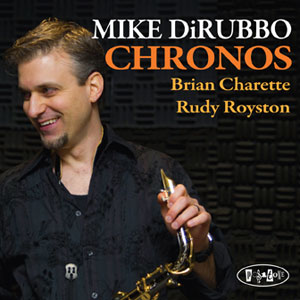
Peter Hum reviews Mike DiRubbo “Chronos”…

communities.canada.com

Chronos (Posi-Tone)
Mike DiRubbo

Chronos, from alto saxophonist Mike DiRubbo, is a quintessentially Posi-Tone jazz CD that delivers high-level post-bop pleasures. DiRubbo’s a direct and passionate player who’s steeped in the power and modal prowess of icons such as John Coltrane and Kenny Garrett, as you can see from this clip:

On his new CD, DiRubbo leads a trio that includes the solid and soulful organist Brian Charette and the crisp and explosive drummer Rudy Royston through nine no-nonsense blowing vehicles of his own devising. The playing’s always committed and eloquent, and DiRubbo explores different moods within the post-bop box, from on the dark, sophisticated, Woody Shaw-style title track on one end to the loping, uplifting Excellent Taste to the more straightforward swingers Eight For Elvin and Lucky 13. The highlights come, in my opinion, when Royston pulls out the stops, which most notably happens on the disc’s brisk, punchy opener Minor Process, on More Physical, the simple but substantial disc-closer that features DiRubbo’s soprano saxophone, and on the taut groove tune Rituals.


Posted on

Richard Kamins Step Tempest review of Captain Black Big Band….

steptempest.blogspot.com

TUESDAY, MARCH 29, 2011

Powerful Sounds

Captain Black Big Band (Posi-Tone Records) – Positive comments have been swirling for several years about this large aggregation.  Founded and led by pianist/composer Orrin Evans(and named for one of his pieces, which itself was named for his father’s favorite pipe tobacco), the CBBB features musicians of all ages, many based in the Philadelphia, PA, area.  And, it’s a “workshop” band in that everyone can bring in pieces and/or arrangements.

The music on the band’s debut CD, recorded live on 3 separate evenings (1 in Philly at Chris’ Jazz Cafe, 2 in New York City at the Jazz Gallery), is, at turns, raucous, provocative, attractive, shiny and without a dull moment.  The program blasts off right out of the chute with “The Art of War“, a  piece by Evans’ long-time employer, drummer Ralph Peterson. Powered by drummer Anwar Marshall and anchored by bassist Mike Boone, the piece features a incendiary solo from alto saxophonist Rob Landham atop a thunderous arrangement by Todd BashoreGianluca Renzi’s “Here’s The Captain” opesn with an impressionistic solo piano spot from Evans before moving into a medium tempo modal work. te composer, who also arranged the work, moves the theme around the brass section. Second time through, the reeds get the opening phrase before the brass take the melody once more.  Tenor saxophonist Victor North delivers a robust solo before Evans takes the spotlight for a swinging, riveting, spot.

Other highlights include “Captain Black” with finely textured solo from pianist Jim Holton and a boisterous “shoutout” by trombonistStafford Hunter. Between those two solos, tenor saxophonist Ralph Bowen goes on an engrossing journey filled with twists, turns, questions and resolution.  “Easy Now“, also composed by Evans, starts off in stentorian fashion with the reeds and brass making a bold statement above the thunderous drum work of Gene Jackson.  Todd Marcus’s arrangement moves the melody into a gospel feel – there is a fine measured solo from trumpeter Tatum Greenblatt followed by a more aggressive turn from baritone saxophonist Mark Allen. When the horns and reeds return at the climax of Allen’s solo, one feels the temperature rise dramatically.  The CD closes with “Jena 6“, Evans’ piece dedicated to the 6 black teenagers from Louisiana convicted of beating a white teen after a series of racially inspired incidents in the town of Jena.  Originally recorded as a trio piece with Tarbaby, the leader’s multi-sectioned work has an ominous tone, from pianist Neil Podgurski‘s unaccompanied opening to the melody line (that has shades of Charles Mingus throughout) to Jaleel Shaw’s long and impassioned alto saxophone solo, delivered over shifting tempos created by drummer Donald Edwards and bassist Luques Curtis. There are moments during Shaw’s journey where the squalling brass and thunderous drums express anger and rage – Shaw’s unaccompanied cadenza that ends the piece is intense, indignant and without remorse.

In the past several years, there have been a number of excellent large ensemble recordings, from Darcy James Argue’s Secret Society to trombonist Alan Ferber’s Nonet with strings to John Hollenbeck’s 2 fine recordings to Charles Tolliver hearty organization (and more).  Orrin Evans and Captain Black Big Band’s debut is the equal to all those, a powerful statement that brings together musicians, composers and arrangers of all ages to create music that rails against injustice, teaches us about cooperation and allows each one to raise his or her own voice above the “white noise” of daily existence.


Posted on

Bruce Lindsay’s AAJ write-up for Orrin Evans “Captain Black Big Band”….

www.allaboutjazz.com

The man behind the Captain Black Big Band is pianist Orrin Evans. The ensemble’s eponymous debut recording is a CD of such style, musicality and instrumental power that it seems only right to ensure that Evans gets the credit upfront. This is straight-ahead, swinging, big band music, recorded at three live performances in New York and Philadelphia in early 2010. The tunes may be familiar—Evans has recorded some of them more than once—but the new arrangements ensure that the band has a contemporary sound that draws from and adapts big band history rather than merely borrowing it unchanged.

Of course, it’s not all due to Evans: each of the musicians contributes to the Captain Black sound. While Evans is the bandleader and main composer, he’s by no means the dominant instrumental voice on the album, taking only one solo, on Gianluca Renzi’s silky “Here’s The Captain.” There are plenty of other fine soloists within the group, and Evans makes effective use of their talents. “Jena 6,” written and arranged by Evans, features two of the best, in Neil Podgurski’s metallic, angular piano and Jaleel Shaw’s looping and swerving alto work.

Evans’ own “Captain Black” is the tune that links most directly to the big bands of the past, with saxophonist Todd Bashore’s arrangement giving it aCount Basie feel. “Easy Now,” another Evans tune this time arranged by bass clarinetist Todd Marcus, is the most reflective and romantic number. It’s loose-limbed and rather melancholy, with Gene Jackson’s drumming charting its ebb and flow while baritone saxophonist Mark Allen and trumpeter Tatum Greenblatt deliver strong and atmospheric solos.

Evans has been part of some fascinating jazz ensembles, most notably Tarbaby, whose End Of Fear (Posi-Tone) was one of 2010’s finest releases.Captain Black Big Band is an emphatic demonstration of his ability to lead an innovative and vibrant orchestra that can surprise and entertain in equal measure.


Posted on

Dan Bilawsky’s AAJ review for Noah Haidu “Slipstream”…

www.allaboutjazz.com

What do slipstreams and music have in common? The simple answer is: flow. While some genres have turned their back on the idea of letting each piece of music flow in its own unique way, subscribing instead to digital quantizing and beat perfection, jazz isn’t one of them. On his appropriately titled debut, Slipstreams, pianist Noah Haidu presents eight unique tracks that are as unpredictable as the flow of air in the wake of an airplane propeller.

Haidu tapped some heavyweights for this recording, including trumpet giant Jeremy Pelt and Thelonious Monk Saxophone Competition-winner Jon Irabagon, and both men prove to be perfect for his music. They deliver warp speed solos over up-tempo swing (“Slipstream”) and blend beautifully when winding their way through the head on Haidu’s “Soulstep.” Pelt’s broad-toned trumpet confidently swaggers over the rhythm section on “The Trouble Makers,” and both men duke it out in a no-holds-barred brawl on “Break Tune.” Irabagon’s playing with the left-leaning, humor-heavy ensemble Mostly Other People Do The Killing has marked him as an avant-garde adventurer in the minds of some jazz fans, but this music is an excellent example of his stellar playing in a more settled vein.

While the horn players deserve a good amount of credit for their contributions to these pieces, it’s still Haidu’s show, and has his hands—figuratively and literally—in everything that happens on this album. Whether the band is moving through an organically flowing waltz (“Float”), a slightly slick vehicle (“Take Your Time”) or a reshaped standard, molded to fit with Haidu’s vision (Cole Porter’s “Just One Of Those Things”), he always finds the perfect part for each song. “Where We Are Right Now” is an excellent example of Haidu’s holistic view of the piano’s role in music. He sets up the rhythmic direction of the music with his chordal statements, supports the horn lines, enhances some of bassist Chris Haney’s movements and solos with passion and purpose. He even seems to develop a telepathic rapport with drummer John Davis, as both seem to lock in with one another and turn up the heat during Haidu’s solo spot.

Slipstream soars and flows in all the right ways with Haidu piloting his music from the piano.


Posted on

Ni Kantu review for Mike DiRubbo “Chronos”…

cliffordallen.blogspot.com

MIKE DI RUBBO
Chronos
Chronos is altoist Mike DiRubbo’s sixth date as a leader and the first to feature him within the bristling context of organ and drums. A student of Jackie McLean (among others) at the Hartt School of Music, DiRubbo has gone on to work with a number of luminaries of modern straight-ahead jazz, such as trumpeter Jim Rotondi, trombonist Steve Davis, pianist Harold Mabern and drummer Joe Farnsworth. He’s joined here by drummer Rudy Royston and organist Brian Charette; the leader and the organist contribute all of the disc’s nine compositions. The opening “Minor Progress” certainly sounds like an ode to McLean’s mid-60s recordings in its stop-time trills and chugging bursts; DiRubbo is a little cooler than his mentor, picking apart thematic nuggets and worrying them in passages that also nod ever so slightly to Marion Brown. “Cool” isn’t to say unemotional – it’s clear that he’s a player with a lot of heart and energy – but more that one can hear him thinking for the first part of his solo, until he puts the gas pedal down and soars over a mighty rhythm clip. Charette has, like Larry Young or John Patton, a pianistic approach to the organ that fits nicely with the tune’s incisive character, though his solo is a bit brief.The title track that follows has overdubbed altos at the outset, giving the introduction a bit of a Living Space vibe, Royston and Charette spinning an Elvin-Young whorl behind DiRubbo’s searchingly sharp eviscerations, which alternate with passages of soft, lyrical introspection. Charette has a bit more space here, carving out a jaunty groove with subtle surges and eddies as bass pedal and drums keep loping time before the leader takes it out. “Rituals” is a decidedly funkier piece, supported by agitated backbeat and a simple, driving chord progression as DiRubbo builds tart phrases and burbling cries in curious opposition to the tune’s initial feel and expected outcome. A somewhat psychedelic, gooey organ statement shifts the tune’s direction yet again, building upon simplicity into dense, anthemic closure. The set is well-balanced between these more uptempo tunes and caressing, urban-twilight ballads that, when in good hands like these, offer another side of the trio’s capabilities. DiRubbo’s approach on “Nouveau” is delicate and slightly bitter, his improvisation full of quiet flurries and athletic runs that are still within the character of the piece, while steering clear of an easily embodied saccharine approach. I’m still wishing for a hotter recording quality on these Posi-Tone discs and I think that Chronos would benefit from that, but all in all it’s an excellent neo-bop date that should be heard, especially if one is pondering a dearth of truly engaging modern jazz recordings.

Posted on

Dan Bilawsky’s AAJ review for Captain Black Big Band…

www.allaboutjazz.com

The Posi-Tone label has positioned itself as a prime purveyor of small group jazz, with artists like pianist Orrin Evans leading the way, and both parties are breaking new ground with the release of The Captain Black Big Band. After putting out dozens of small group sessions, the label has taken a bold step in a bigger direction by releasing the debut big band recording from one of jazz’s rising stars. Evans’ prior output for the label—his ownFaith In Action (Posi-Tone, 2010) and the audacious collective efforts on Tarbaby’s The End Of Fear (Posi-Tone 2010)—present an artist possessing a keen sense of balance between inside and outside ideals, and this same approach can be felt throughout this record.

The first three numbers spotlight three different composers and arrangers, which demonstrating the full breadth and depth of what this band can do. The full weight of the ensemble is used sparingly on Todd Bashore‘s arrangement of Ralph Peterson‘s “The Art Of War,” and the focus really falls on Rob Landham’s helium-infused alto saxophone work. The band touches on Latin grooves with Gianluca Renzi‘s “Here’s The Captain,” which features some explosive piano work from Evans, and Todd Marcus‘ arrangement of his own “Inheritance” demonstrates a more melodically centered form of big band writing. His bass clarinet work adds a new dimension to the sound of the band, and trumpeter Walter White injects some humor into the proceedings with a “Hallelujah” quote from Handel’sMessiah.

The last four tracks are penned by Evans, giving the music a certain sense of continuity, but the pieces themselves come from different points in Evans’ compositional evolution, and three different arrangers put their own unique stamp on his work. Bashore arranges a pair of tunes from Captain Black (Criss Cross, 1998)—the title track, and “Big Jimmy,” an album highlight where the saxophonist uses measured dissonance in the introduction and, once things start swinging, White’s brawny trumpet work is as beautifully boisterous as it gets. Marcus tackles the title track fromEasy Now (Criss Cross, 2005), underscoring some high-to-low voice contrasts at the outset with some rumbling drums, as the music eventually takes on a down-tempo, loose swing vibe.

Evans’ own arrangement of his “Jena 6,” from the Tarbaby album, is the recording’s most adventurous ride. Neil Podgurski‘s drama-filled piano prelude, with certain disjunct sensibilities, gives way to a woozy and ominous atmosphere. Alto saxophonist Jaleel Shaw becomes the focal point, as the rhythm section coalesces into a free bop machine and the icing on the cake comes in the form of Shaw’s coarse-as-can-be coda, which boils over with energy.

The Captain Black Big Band has easily earned its stripes with this self-titled debut, demonstrating another side of Evans’ endlessly fascinating musical personality.