Posted on

Lucid Culture reviews Noah Haidu “Slipstream”…

lucidculture.wordpress.com

Noah Haidu’s Slipstream Floats Away

Jazz pianist Noah Haidu has an intriguing new album just out on Posi-tone. Haidu has an individual style – he wanders and hints at melody, with deft use of chromatics, rather than hitting it head-on. That role is left to the horns here, and he’s got a couple of really good ones, Jeremy Pelt on trumpet and Jon Irabagon on alto sax, along with Chris Haney on bass and John Davis on drums (with Willie Jones III behind the kit on three tracks). Haidu aims for an update on a classic 50s hook-based style, with judicious shifts in time and tempo, plenty of room for some choice solo spots and an inevitable return to the head or the hook at the end of the song.

Jones gives the cheery opener, Soulstep, a steady clave beat, Pelt and Irabagon both cutting loose with good-natured, lyrical solos, Haidu right behind them. The stern chords that open Where Are We Right Now are a false alarm: it morphs into a bright ensemble piece, Haidu adding a bit of a rattling, funky edge, Irabagon spinning through the clouds with an effortless grace: it’s hard to imagine that the purist pro at work here has an alter ego whose antics have made recent albums by Bryan Murray andJon Lundbom so hilarious. The title track maintains the upbeat vibe, a brisk blend of old (30s, vaudevillian) and newer (60s, loungey). Break Tune builds off a staggered, Monk-ish piano hook, Irabagon playing good cop to Pelt’s repeat offender as the trumpet mauls the end of a series of swirling Irabagon phrases.

The judiciously brooding piano ballad Float, a trio piece with bass and drums, is a blues in disguise, followed by Take Your Time, wistful and simple with a purist pop feel. Another trio piece, Just One of Those Things gives Haidu a launching pad for some particularly tasty, bluesy horn voicings as he works his way up the scale. They close with a genial, 50s style swing theme, The Trouble Makers, which exemplifies everything that’s good and also frustrating about the album, including but not limited to the indomitable rhythm section and Pelt’s genial soloing. Trouble is that by now, the tropes that Haidu has fallen back throughout the album have past their expiration date as far as maintaining suspense, or for that matter maintaining interest. Does that staccato chromatic run up the scale mean the end of the solo? Of course it does, weren’t you listening when that happened ten minutes ago? Or the time before that? This is the kind of album that works best as an ipod shuffle: most every track here is a good choice for spicing up a mix or adding a hit of energy between slow ballads. And it’s reason to keep an a eye on Haidu to see what he puts out next.


Posted on

Posi-lutely (CD reviews) by Peter Hum

communities.canada.com

Los Angeles-based Posi-Tone Records sends me red-meat jazz discs faster than I can keep up with them. Here’s what I think of some of the label’s most recent releases from musicians who have been on its roster for a while now:

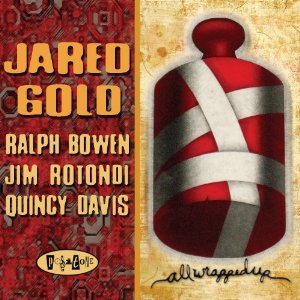
All Tied Up (Posi-Tone)
Jared Gold

The latest CD from organist Jared Gold could equally have been billed as an outing by the Posi-Tone All-Stars. The fourth disc by Gold on Posi-Tone in as many years, All Tied Up features Gold with label-mates saxophonist Ralph Bowen and trumpeter Jim Rotondi. Completing the quartet is drummer Quincy Davis, on faculty these days at the University of Winnipeg’s jazz program. He has a precise, powerful hookup with Gold and contributes just the right crackling swing.

The disc is all about swinging fiercely and blowing hard, with an occasional break for a bit of funkiness. Gold contributes five of eight tracks and there’s one apiece from each of the other musicians. Gold’s My Sentiments Exactly and Get Out of My Sandbox and may not be so striking when it comes to their titles, but they’re rousing themes that give the CD plenty of ignition as Gold, Bowen, Rotondi and Davis tear into them. Gold’s a potent player coming out of Larry Young’s arresting modal style, and he draws on the organ’s sonic possibilities to spur the music on. Bowen, one of Saskatchewan’s biggest gifts to jazz, is an absolute terror thanks to his passionate sounds when it comes to exploring chords with long lines. Rotondi steps up and sounds sassy on this disc, a bit Hubbard-like at times, only more mortal.

The disc is pretty much balladless if we’re talking about songs that express tenderness or romance. Instead, the slow songs Dark Blue (by Rotondi) and Gold’s own Saudades are more in keeping with the disc’s muscular, bopping vibe. Mama Said, and the closer, Just A Suggestion, funky, gospel-tinged.

Power Play (Posi-Tone)
Ralph Bowen

On his third Posi-Tone disc in as many years, saxophonist Bowen works his way deeper into the post-bop bag that he’s been exploring for almost three decades. In the mid-1980s, soon after he graduated from Rutgers University, the Guelph native was tapped for the post-Wynton, Young Lions outfit Out of the Blue, which also included Renee Rosnes and Kenny Garrett in one of its incarnations. A stylistic straight line connects the music on those OTB records and the hearty, hard-swinging fare on Bowen’s aptly named Power Play CD.

Bowen’s made his reputation as a virtuosic, eloquent tenor player, and on tracks such as the swaggering KD’s Blues, the brisk harmonic slalom Two-Line Pass, the urgent modal exhortationThe Good Sheppard, and the lyrical but exciting Walleye Jigging, his flowing lines and rhythmic drive consistently delight. Bowen’s one of many saxophonists of his generation who flow out of the John Coltrane-Michael Brecker branch of tenor saxophone, but he’s certainly among my absolute favourites in this subset of hornmen.

That said, Bowen branches out on this disc, demonstrating how he can express himself on other horns. On one track, he plays alto saxophone (the knotty, intense, BreckerishDrummheller Valley, which finds him in a few spots recalling his former OTB bandmate Garrett). On two change-of-pace tracks, Bowen plays soprano saxophone. The slow, waltzing Jessicaand the disc’s closer, A Solar Romance are fine, although the latter tune’s placement at the end of the disc gives Power Play a less powerful finish.

Alternately, the disc might have ended with its only standard, a gorgeous, classic My One And Only Love, to send listeners out with a reiteration of Bowen on his primary horn. It sounds like it could have been a classy set-ender to me, akin to a ballad encore.

Bowen’s rhythm section consists of the Philadephia pianist (and Posi-Tone recording artist) Orrin Evans, who is unfailingly interesting as he draws upon pianists from Wynton Kelly to McCoy Tyner, bassist Kenny Davis (an OTB alumnus like Bowen) and drummer Donald Edwards, a snappy, convincing player.

Captain Black Big Band (Posi-Tone)
Captain Black Big Band

Here’s a video that says what the Captain Black Big Band, directed by pianist Orrin Evans, is all about:
The group’s eponymous CD features seven tracks culled from three nights of gigging in Philadelphia and New York. Regardless of when and where the music was recorded, the excitement on the bandstands and in the rooms is clear. While I sometimes wish the disc’s recording quality was better, it still allows the whoops and exhortations of the band members to be heard during the driving performances.

The first few tracks on the CD lean toward minor modal thrashing. Case in point is the opener, Art of War by drummer Ralph Peterson.

On the disc, Art of War is a punchy, concise opener, featuring Rob Landham’s tart alto saxophone. It’s followed by two tracks that extend the minor modal vibe — Here’s the Captain, a lush Latin tune by Gianluca Renzi that features saxophonist Victor North, and bass clarinetist Todd Marcus’ Inheritance, which pulls from John Coltrane’s India, and which allows Marcus and the Handel-quoting trumpeter Walter White to stretch out.

Big Jimmy, the first of four Evans tunes, is a bright, classic swinger. Trumpeter White seizes the tune by the horns during his solo, and Ralph Bowen contributes a sprinting soprano saxophone turn. Captain Black offers some swaggering swinging, and Bowen is back, tearing through the changes.

Easy Now, the disc’s longest, slowest track, feels a bit baggy to me at first as it moves through its rumbling overture — better recording quality would likely have helped — but the piercing trumpeter Tatum Greenblatt lifts the music up during his feature.

The disc closes with its most intense piece, Jena 6, which is named after six black youths in Louisiana whose arrests on an assault charge gave rise to massive civil rights demonstrations in 2007 (trumpeter Christian Scott’s composition Jenacide is similarly inspired). After the tune’s initial, dirge-like passage, alto saxophonist Jaleel Shaw is utterly searing as the tune moves from roiling, rubato to fast, frenetic swinging to a Coltrane-style ovation. Shaw finishes the tune by himself, adding some screech to his sound during the powerful cadenza.

The End of Fear (Posi-Tone)
Tarbaby

The End of Fear is the stylistic outlier of this batch, eschewing Posi-Tone’s primarily post-bopping sensibility for music with more jagged edges and not-so-thinly-veiled social commentary.

The clearest link to Posi-Tone is pianist Orrin Evans, who joins bassist Eric Revis and drummer Nasheet Waits to form Tarbaby. Guesting on selected tracks are trumpeter Nicholas Payton, tenor saxophonist J.D. Allen and alto saxophonist Oliver Lake.

The disc’s four shortest tunes function as interludes but they’re also bursts of energy and attitude that tell you a lot about where Tarbaby’s coming from. The first of them is the opener by Revis, E-Math, which combines dark fractured funk lines with layers of mysterious muttering — snippets such as “Does it swing?” “Swing is old,” “The only way you can could swing is from a tree — put a noose around your neck,” and “Where’s the melody?” compete with someone muttering mathematical gibberish. Heads is a condensed bit of meta-music and protest, opening with the words, “Jazz. The word to me means freedom of expression. That’s what I think of it. That’s all.” Someone yells “Go!” and after a minute and half of tumultous free playing, the track ends with Malcolm X saying — apropos of the disc’s title — “No, I don’t worry. I have no fear whatsoever of anybody or anything.” Tails is an roiling, miniature companion to Heads. The CD’s other sub-two-minute track is a run through the Bad Brains’ Sailin’ On, true to its hardcore punk spirit.

Also defiant, and in a more programmatic way, is Evans’ Jena 6. Performed by Tarbaby’s core trio, it’s more mournful and less fierce than the version heard on Evans’ big-band recording.

While they may not be so explicit in their politics, covers of pieces by Sam Rivers (Unity) and Andrew Hill (Tough Love), as well as Oliver Lake’s urgent, start-and-stop swinger November ’80 are similarly spirited. In a similar vein, Revis’ Brews is, in fact, a blues and a waltzing, fractured one at that.

In the middle of the CD, there’s a moment of rest when the trio, joined by Allen, offer a melancholy, beautiful reading of Fats Waller’s Lonesome Me, stressing its melody over any flourishes of improvisation.

Hesitation by Waits, which features Payton, begins as a rumbling ballad but grows to be florid and turbulent. Paul Motian’s Abacus provides a wispy, ethereal conclusion for a CD that for much of its duration was spiky, tense and audacious — to the point that it did not sound quite like a Posi-Tone CD.


Posted on

Dan Bilawsky reviews Jared Gold “All Wrapped Up” for AAJ….

www.allaboutjazz.com

There’s a noticeable change in organist Jared Gold’s sonic template of choice, before All Wrapped Up even begins. While two out of Gold’s three prior releases were quartet outings that used saxophone as the lone horn voice, all three releases were rooted in the traditional organ trio instrumental format. A different guitarist graced each one of those records, with Randy Napoleon, Ed Cherry and Dave Stryker each putting their own unique stamp on Gold’s music, but the organist clearly felt it was time to move on, with guitar nowhere to be found on this album. Instead, Gold turns to two stellar horn players (and label mates) to help flesh out his new sound. Saxophonist Ralph Bowen and trumpeter Jim Rotondi add their own singular voices to Gold’s music as the organist creates the next chapter in his career as a leader.

Five of the eight compositions on the album come from Gold, and the funkiest fare stands out above the rest. “Mama Said” starts off with both horns working through the hip head, as drummer Quincy Davis lays down an easy funk beat and things get even more soulful as solos are passed around. The album-closing “Just A Suggestion” has a few more rhythmic turns in the mix, but moves in a similar direction. Bowen’s solo is the clear highlight on this one and his passion for the music is palpable.

While more than half of the material comes from Gold, each member of the band contributes one piece. Davis delivers a relaxed swinger (“Piece Of Mine”), but Bowen’s “Midnight Snack”is a rhythmic rollercoaster ride, where the groove terrain is in a constant state of flux—though everyone knows exactly what they’re doing—as the rhythmic underpinnings continually shift. Rotondi’s “Dark Blue” follows, a mellow swinger that’s the calm after the storm.

When All Wrapped Up reaches its conclusion, two things are abundantly clear: this newfound quartet format hasn’t dampened or diminished the creative enthusiasm shown on Gold’s earlier releases; and the album continues the steady evolution of one of jazz’s most prominent rising star organists.


Posted on

Sax Shed reviews Dave Juarez “Round Red Light”…

saxshed.com

Dave Juarez – Round Red Light Print E-mail
Barcelona native Dave Juarez has released Round Red Light on Posi-Tone Records. Guitarist Juarez features extraordinary tenor saxophonist Seamus Blake, prodigious John Escreet on piano, Lauren Falls on Bass and Bastian Weinhold on drums.

In this day and age we am seeing far more EPKs sent out to reviewers and promoters rather than the traditional “hard copy” cd promo packages. The EPK (Electronic Press Kit) is an ingenious bi-product of our “I need it yesterday” society. On more than one occasion I have found myself beginning to review the contents of a recording only to be duped by my iTunes playlist. Today, I was listening to the opening cut of Round Red Light, completely enjoying Juarez’s group and particularly Seamus Blake’s playing. The second cut sounded markedly different and seemed a cover of Dexter Gordon’s Cheesecake. Having a keen sense of the obvious, I quickly realized this WAS Dexter on my shuffle play, not the intended second cut. Unfortunately, this continued to happen after every cut on Round Red Light. Seems it’s a sign of the times and time to change my preferences on iTunes.

Hard copies and EPKs not withstanding, the opening track Montpellier View maintains an American folk quality in the melodic introduction. This is quick to change as Seamus Blake and his identifiable tenor sound begin to solo. Seamus plays in rhythmic bursts and occasionally into his seemingly effortless altissimo. Guitarist Juarez solos in a generous second position before the group states the head one last time.

Round Red Light embarks on its musical journey with a lovely solo guitar intro by bandleader Dave Juarez. Blake takes the melody in unison with Juarez on guitar. Juarez’ guitar melody is like a spice, only joining the tenor for flavor here and there in between chord structures. Blake’s tone is full and clear, neither bright nor dark. The vibe of this tune reminds me of Coltrane’s Naima or perhaps Central Park West. It is quite appealing.

Lonely Brooklyn is an up-tempo yet somehow almost sad Latin tune initially featuring pianist John Escreet. It’s difficult to hear a tune in this setting, featuring piano and not make comparisons to Chick Corea. Any comparison that can be made to Chick’s groups and their various incarnations is purely deserved flattery. When Seamus Blake begins to solo the group is clearly headed in a different direction. Again the melody features unisons between guitar, tenor and also piano.

The soft and pensive The Echo of Your Smile is a likeable melody played in unison by Blake and Juarez. This time bassist Lauren Falls solos first, followed by a bit of musical meandering. The ambiguity that follows the bass solo gradually leads the listener into the guitar solo. The understated guitar solo almost leaves more room for the interplay from Falls, Escreet and Bastian Weinhold on drums. Seamus and Juarez bring us back with the unison melody amidst Falls soloing on bass and Escreet cascading downward on the ivory keys. Somehow it all seems to work quite well.

Belleza Anónima begins with Seamus Blake in the upper register of the tenor sans vibrato. The vibe here is a bit reminiscent of the old ECM recordings featuring Jan Garbarek. Whether by coincidence or design it is a very desirable sound and the tune a great vehicle for Blake’s playing in this style. At about 3:30 into Belleza Anónima Seamus definitively displays why he is one of the premier tenor saxophonists of today. The ensemble finishes big – or seemingly so, with a huge cadence and no resolution. Way to leave us hanging guys!

The upbeat and swinging Serotonina wonderfully gives the group a chance to show their chops and stretch out. Juarez solos first, followed by a complex and musical escapade from Escreet on piano. Tenor bass and drums follow as Seamus Blake begins his own excursion, eventually joined by the entire ensemble. By the title, one has to wonder if there is a mentally unbalanced girl out there named “Nina.” There is however, nothing unstable about this groups playing.

Among the final compositions is the ballad La Noche Oscura Del Alma, and Luna De Barcelona, which highlights an angry yet well-done solo from Seamus Blake, punctuated by Weinhold’s cymbals.

The final cut RNP seems another ballad beginning with the duo of Dave Juarez on guitar and Seamus Blake on tenor. It quickly and deceptively turns into a frantic 6/8 (or is it 12/8?) groove which enables the group to collectively interact and experiment as not heard previously on Round Red Light.

Dave Juarez’s Round Red Light is an easy listen for any lovers of jazz and saxophone. Seamus Blake is among the top tenor saxophonists of modern day. He continuously allows himself to be surrounded by only the best jazz musicians such as Juarez, Escreet, Falls and Weinhold.

You can get your own copy of Round Red Light starting on April 19, 2011. Visit Posi-Tone Records for more info.


Posted on Leave a comment

Some more coverage for the new Mike DiRubbo “Chronos”CD….

burningambulance.com

Alto saxophonist Mike DiRubbo has been around the New York scene for a while, doing the straight-ahead hard-bop thing. He studied with Jackie McLean, and has played with a number of highly regarded musicians older than himself, including Eddie Henderson, John Hicks and Clarence “Gatemouth” Brown. Chronos is his sixth CD as a leader, and his second for the Posi-Tone label. On his last album, 2009′s Repercussion, he fronted a band featuring vibes, bass and drums. This time out, he’s stripped it down to organ and drums (played by Brian Charette and Rudy Royston, respectively), and the results are stark and at times surprisingly hard-hitting. It would be unfair to suggest that this is an assaultive or even especially free record. Most any Larry Young Blue Note album would offer a greater level of raw abstraction; DiRubbo is a blues- and bop-based, swinging player, and given that every track here is either one of his compositions or written by Charette, the general vibe is one of soulfulness and groove. And yet…there’s some aggression here that vaults Chronos out of the pack of boring, hockey-rink organ-jazz discs. There are moments, during Charette’s solo on the title track, that almost venture into Keith Emerson (of Emerson, Lake & Palmer) territory, and later in the same piece, DiRubbo latches onto a three-note phrase and goes after it like a dentist drilling into the listener’s back-most molar, before embarking on a solo with some surprisingly screechy, harsh moments. That solo’s an exception, though. For most of the disc, DiRubbo is the stabilizing force, attempting to keep things in a gently bopping zone that wouldn’t throw the folks who come to jazz clubs to eat wildly overpriced chicken entrees. But Charette seems bent on subversion; at the end of “Excellent Taste,” which he wrote, he plays a hypnotic, almost psychedelic pattern as the track fades down, and it’s the best thing about the piece. Similarly, his work on the bluesy “Eight for Elvin” is weirder than it needs to be; some of his lines sound more indebted to Ray Manzarek of the Doors than to Jimmy Smith, John Patton or any other jazz organ player. Meanwhile, Rudy Royston attacks the drums with more than enough force to justify the track being titled in tribute to Elvin Jones, known as one of jazz’s hardest hitters during his time with John Coltrane. Royston also drives the band quite hard on the hammering (“uptempo” doesn’t do it justice) “Rituals,” and even when he’s laying down a relatively staid Latin groove (“Lilt,” which lives up to its title), he finds a way to do something interesting. And on the album’s closing track, “More Physical,” which could have been a deal-breaker, given that DiRubbo plays the (ugh) soprano sax, the drummer throws in enough unexpected accents with the toms and the rim of the snare that things stay interesting all the way to the four-minute mark (of five and a half), when the leader’s solo becomes quite shockingly piercing, as though Najee had suddenly become possessed by Evan Parker. The piece ends in soul jazz-meets-free jazz territory, which ought to come as a major surprise to fans of DiRubbo, Posi-Tone Records, and sax-organ-drums combos alike. This isn’t a skronky album by any means. But if you put it on and expect to curl up on your couch with a book, don’t be surprised if you find yourself glancing worriedly at the speakers a time or two.

Posted on

Jazz Wrap covers Jared Gold “All Wrapped Up”….

jazzwrap.blogspot.com


TUESDAY, APRIL 19, 2011

Jared Gold

Jared Gold (organ)

All Wrapped Up (Posi-Tone Records)
Jim Rotondi (trumpet)
Ralph Bowen (sax)
Quincy Davis (drums)
Jared Gold is one of those organ players that uses the instrument more like a piano than an instrument to bang out chords. Like the legends Larry Young, Shirley Scott, or Jack McDuff, he uses his compositions and band mates to construct an impressive and unique environment around himself. Gold creates beauty within a soulful jazz groove that quickly becomes infectious. But you the listener will be more influenced by the performances of this quartet more than the idea of a funky groove.
And that idea is clear and on display throughout All Wrapped Up, Gold’s fourth album as leader. Opening with the fiery “My Sentiments Exactly,” Gold makes a bold statement that this will be a heavy session but with a lot emotion and input from his fellow bandmates. This time around he circles himself with a superior lineup of Ralph Bowen, Jim Rotondi and Quincy Davis, all of whom have played with Gold in one incarnation or another. But on All Wrapped Up each member contributes to the session giving the proceedings a versatile and dynamic nature. Bowen is the real highlight on “My Sentiments Exactly” as he exchanges some tonal acrobatics with Gold that really get this piece smokin’ during the mid-section. Awesome stuff.
Another set of soulful notes occurs on “Piece Of Mine” which sees Bowen, Rotondi and Davis delivering some very romantic rhythms. Jim Rotondi continues to show why he is one most electrifying hard bop trumpeters on the scene today. He delivers some hard poppin’ solos during this piece, while Quincy Davis and Gold share some head-bopping, toe-tapping grooves that holds the listener’s excitement throughout. “Dark Blue” is as it sounds, more a deep ballad with Gold effectively shaping the sound from the outside in. He adds some deeply soulful tones that construct a more Jimmy Smith or Doug Carn atmosphere than the usual aforementioned influences. “Dark Blue” was written by Jim Rotondi, so it is expected that he would shine with delightful solos along with Bowen.
“Just A Suggestion” sees the group really move into the funky Meters-type realm. Definitely a barn-burner if you hear it live. The group really lets loose and you feel the fire that builds up throughout the entire session really exploding on this piece. Gold gets the best beats out of Davis on “Just A Suggestion.” A solid group effort to finish out the session.
Jared Gold in just a few short years on scene has really established himself as an upcoming force on the scene as a leader and musician. All Wrapped Up succeeds not just because of the experience of the lineup but also the versatility of the quartets leader. In All Wrapped Up, Jared Gold has made a fourth album that burns and soothes in both sound and composition.


Posted on

Raul D’Gama Rose reviews “Inner Flights” for AAJ…

www.allaboutjazz.com

Inside Benjamin Drazen is an old soul, nestling cheek-by-jowl in a fertile mind, brimful with new ideas that undulate and flow beautifully from his alto saxophone. That he is able to take control of this force, and harness its power to open a virtual door to the temple of his muses—running the gamut of saxophonists from Charlie Parker to John Coltrane, and almost certainly including the mighty Johnny Hodges—speaks volumes about his mature craftsmanship. He has something else that shines throughout the rather introspective Inner Flights: a vortex of energy that bursts through the music like a gathering flood, inhabiting both the hearts and minds of anyone who falls under his spell.

The album opens with “Mr. Twilight,” a scorching modal romp that recalls, at times, Coltrane’s “Giant Steps” for all of its unbridled energy, and the wall of sound that passes through Drazen’s hands, as well as pianist Jon Davis, bassist Carlo De Rosa and drummer Eric McPherson. But it is Drazen who lights up the chart, with the dancing phrases and lines that dapple his solo. On this and other charts, the saxophonist shows himself to be a sublime intellect, creating highly literate musical excursions, navigating with lively expression and feeling. He is also capable of being playful, as his composition, “Monkish,” suggests, although this chart finds Davis playing the more stellar role, dazzling with his two-handed technique, as well as a history lesson in pianism, from stride to contemporary atonalism.

Drazen’s premier work, in terms of composition, seems to be more inward-looking, including the achingly beautiful “Prayer for Brothers Gone By” and the lilting “Neeney’s Waltz,” which the saxophonist absolutely lights up with a solo that unfolds in diaphanous swirls, and is a seemingly unstoppable flow of ideas belying sheer genius. His reading of Jimmy Van Heusen’s classic, “Polka Dots and Moonbeams,” takes after a version that Bud Powellmade famous at Massey Hall, Toronto in 1955. This is an elementally sad version, showing Drazen to be unafraid of wearing his emotions on his proverbial sleeve.

Although he plays mainly alto saxophone, Drazen can also be heard on soprano on the title track. His handling of the higher pitched horn is wry, playing with an almost reverential notion that it belongs in elite circles, including not just Coltrane, but a handful of giants from Sidney Bechet to Steve Lacy and Wayne Shorter. Drazen chooses to add depth and color on a couple of charts, by overdubbing tracks with short bursts on tenor. However, it is on the alto that Drazen displays his finest mastery of tone and texture. His work on this impressive album shows him to daub his music from a truly wide palette of not just colors, but sheer creative ideas. All of this makes for brilliant inner flights.


Posted on

Richard Kamins Step Tempest review for Jared Gold “All Wrapped Up”…

steptempest.blogspot.com

There’s something about the Hammond B-3 organ that makes it just right for “soul-jazz.”  Over the years, musicians such as the “Jimmys” – Smith and McGriff – Charles Earland, Larry Young and Joey De Francesco have played all sorts of tunes utilizing the big organ.

Jared Gold continues in the long tradition of blending hard-bop and soul elements into a tasty aural treat. His 4th release for the L.A.-based Posi-Tone Records label, “All Wrapped Up“, replaces the guitar in his ensemble with saxophonist Ralph Bowen and trumpeter Jim Rotondi, both players who know how to heat up a session. Add to the mix the incendiary drumming of Quincy Davis and the program is fun from note one. The explosive opening track, “My Sentiments Exactly“, sets the pace – listen to how Gold rides easily atop Davis’s race-car drive and the way Bowen and Rotondi rise to the occasion. The soulful strut of “Piece of Mine” has a handsome melody voiced by the trumpet and saxophone.  Rotondi seems to build his solo off both the rapid-fire snare drumming and organ fills while Bowen sways over the beat.  Gold really digs in for his 2-handed foray (his footwork on the bass pedals is dandy throughout.)

Other highlights include “Saudades“, which hints at Latin roots but slides lightly atop Davis’s sparkling cymbals and Gold’s full-voiced chordal work.  Then, there is the “fatback funk” of “Mama Said” with strong solos all around led by the “can’t miss” beat provided by Davis.

All Wrapped Up” is fun music, great for turning up the speakers and shaking the walls.  Gold unselfishly shares the spotlight; it’s all for good that both Bowen and Rotondi are fully committed to make the session successful.  With Quincy Davis piloting the ship from the drum set, this CD is a real treat. For more information, go to www.posi-tone.com.

Here’s the opening track, courtesy of Posi-Tone Recordsand IODA Promonet:

My Sentiments Exactly (mp3)

POSTED BY CULTURECREATURE (RICHARD B. KAMINS) AT 10:21 AM
Posted on

Urban Flux chimes in about Dave Juarez “Round Red Light”….

theurbanflux.wordpress.com

Dave Juarez -][- ROUND RED LIGHT – [Posi-Tone Records, 2011]

It’s all systems go as Barcelona native Dave Juarez takes us along a new Jazz tangent on his breathtaking debut release “Round Red Light.” This exciting musical program covers a wide variety of avenues as guitarist Juarez’s brilliant original compositions are presented by an amazing group of players, including the award winning saxophonist Seamus Blake, celebrated prodigy pianist John Escreet, bassist Lauren Falls, and drummer Bastian Weinhold. “Round Red Light” is definitely straight ahead and features some spectacular solo performances, but more importantly Juarez’s compositions are indicative of a more modern jazz sensibility.

Critical listeners will enjoy the remarkable program of original compositions and should agree that “Round Red Light” announces guitarist Dave Juarez as someone new to keep an eye on for many years to come.