http://www.allaboutjazz.com/php/article.php?id=40315
http://www.allaboutjazz.com/php/article.php?id=40315
Saxophonist Ken Fowser and vibraphonist Behn Gillece have recently released “Duotone” on Posi-Tone Records.
Every once in a while, I will be presented with a recording for review where my relationship with the artist(s) is more personal. This is the case with “Duotone” by Ken Fowser and Behn Gillece. Perhaps a bit of explanation is necessary. Several years ago as a young teacher I had the pleasure of being around an even younger Ken Fowser. He and his father of the same name were students at a conservatory where I served on the faculty. Both Ken and his father participated in the saxophone quartets I coached. They were mentored by my longtime friend (and my own mentor) Tony Salicandro. Over the years I have heard of Ken’s successes in the music business and only by happenstance found this recording.
Fowser’s sweet and lyrical tenor saxophone sound is perfectly paired with Gillece’s vibes. The first two cuts Overcooked and Spontaneity both swing hard and get “Duotone” off to the quick start. In addition to sax and vibes, the group is rounded out by Donald Vega, piano; David Wong, bass and Willie Jones III on drums.
The third cut, Attachment features Fowser and Gillece on a clever melody riddled with leaping triplet figures. The result is a swinging tune which had a head that sounds much more complex than the triplets may suggest. Gillece plays a wonderful couple of choruses to start out on this minor blues. Fowser solos second followed by Vega on piano and Wong on bass. The solos by all are relatively short, to the point and well constructed.
Back To Back begins with a polyrhythmic melody, which initially disguises this up-tempo swing tune. The pace is furious, yet Fowser navigates the changes beautifully as does Gillece behind him. Playing over this tune is not for the faint of heart and demonstrates what wonderful musicianship this group possesses. Not to be overlooked, Donald Vega plays a particularly technical and spirited solo on piano. His left hand comping under his own solo is equally as compelling as his right hand. Jones is also rewarded some deserved time to shine on the drums prior to the final melodic statement.
The sound of the lesser-used vibraphone is refreshing on “Duotone” and never more apparent than onCome Around Again. The duet between Ken Fowser and Behn Gillece shows a tenderness not otherwise found on this recording. They are patient and stingy with their notes to perfection.
The straight eighth notes of In The Twilight are a refreshing variation at the midpoint of “Duotone.” It is difficult not to make comparisons to one of the few, well-known contemporary vibraphonists. That being said, Gillece does have his own unique approach to the vibes, as does Fowser on tenor.
The cute and swinging Low Ball again is well suited to the sound of vibes and Fowser’s smooth tenor sound. There are no rough edges here, just a pleasant journey set to familiar changes not unlike the standard Satin Doll. David Wong gets a chance to take a chorus on bass here as well.
The bossa nova Bongo seems a tune stuck in time – reminiscent of the wonderful “Bossa Nova Craze” of the 1960s.
Offset is not unlike the earlier Attachment features a melody, which utilizes triplet figures at the onset. The tune unfolds to reveal a medium swing romp with Vega soloing first on piano. Fowser and Gillece also solo before the head finishes the tune.
My personal favorite cut comes at the end with One for G. The quirky, blues with a bridge retains a quality similar to the blues classic Twisted. Fowser’s tone is clean, clear and never ugly. He stays within the traditional register of the tenor here and elsewhere, never feeling the need to explore the outer limits of the altissimo or sometimes barking low register. Gillece and Vega solo, although the none of the soloists feel the need to blow chorus after chorus. They say what they have to say. They get in and they get out.
Ken Fowser has entered a world of jazz riddled with well-trained, technically proficient and creative tenor saxophonists. Somehow his sweet sound is his own, never sounding like anyone but himself. He and Behn Gillece have surrounded themselves with a cohesive ensemble of like-minded musicians who can make their case within only a few, well constructed choruses.
You can find out more about “Duotone” and other innovative recordings at www.posi-tone.com
To paraphrase the poet Robert Burns, “the best laid schemes of reviewers and home owners can be washed away by the eye of a storm.” I was hoping to get a slew of reviews posted before Hurricane Irene arrived but, alas, that did not occur. So, in the interest of time (yes, school is back in session and papers are waiting to be read), here’s a brief look at several excellent new recordings.

I have received a slew of new releases that have impressed me with their emphasis on melody. As opposed to pure “blowing sessions”, the recordings in this review start with well-thought out melodic ideas and build from there.
Let me begin with the splendid new release by alto saxophonist and composer Patrick Cornelius. Hot on the heels of 2010’s trio date “Fierce”, “Maybe Steps” (Posi-Tone Records) expands the basic instrumentation of sax-bass-drums to include piano (the guitar work of Miles Okazaki is heard on several cuts) for a program of 9 originals and 2 standards (K Weill’s “My Ship” and G Shearing’s “Conception“.) Check out the rhythm section which consists of drummer Kendrick Scott, pianist Gerald Clayton (on all tracks but one, a handsome duo take of the Weill tune features pianist Assen Doykin) and bassistPeter Slavov. Much of the music is the direct result of the birth of Cornelius’s daughter “Isabella” and his fatherly fascination in her. The music has a searching quality, a sense of adventure and wonder that is often the purview of very young children. No bumps and bruises along the way, just a sweet collections of tunes. The title track moves easily atop the fine walking bass line and sparse yet effective cymbal work. Clayton’s generous chords push Cornelius into a strong, singing, solo. That is followed by the Satie-esque “Bella’s Dreaming“, with the leader playing these sweet, bluesy, smears that pushes the piece into George Gershwin. It’s a wee bit short at just over 2 and 1/2 minutes but none of the tracks are really long. Scott dances “Shiver Song” in, laying down an irresistible beat that gives all involved just the right push (and a great drum-alto exchange near the close of the piece.)
Nary a sour note on the disc, “Maybe Steps” is delightful music from start to finish. Give it a lot of listens. Release date is 9/20/11. For more information, go to www.patrickcornelius.com.
by SUPERFAN on AUGUST 31, 2011
in INSTRUMENTAL,JAZZ
Let us delve now into the groovin’ jazz vibes of Behn Gillece. Vibes as in vibraphone, bebbeh. Possibly the most pleasing to the ears of all instruments when played by a master, and the most dreadful elevator music-y device when played by a slouch. There is no slouching on this fine instrumental flight, played by virtuosos with sophistication and ease. Ken Fowser joins in on tenor sax on this shimmering number. Most excellent.

Brent Canter (guitar)
These artists are also not making themselves the story of their sessions. It’s the group and the tunes that’s important. Not the histrionics of how well the artist has learned form their studies or history. Now with another guitarist spending time in my CD player, I am again blown away…everyone, meet Brent Canter and his stellar new album, Urgency Of Now (Posi-Tone Records)
The organ work by both Kipple and Bianchi (on selected tracks) is understated and Canter’s compositions don’t allow the instrument to overtake the groups overall mission on each track. “Meet Me Halfway” is lovely in tone and the group are rise to the challenge as the piece moves forward. Changing tempos from bluesy-soul to midtempo ethereal harmonics thanks to Bianchi on this number. Great stuff.
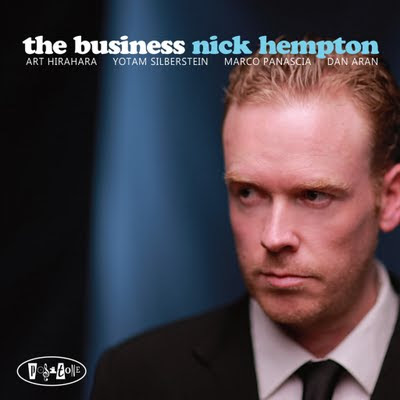
The cooler Mr Hempton and the Nick Hempton band are launching their second CD “The Business” in New York on Saturday Night.
Smalls Jazz Club
183 W10th Street @7th Ave
New York, NY
7.30 – 10pm
Not only is Nick better looking than me but he blows almost as hard as Irene and much much cooler. The reviews have been universally good – but I will understand if you think you need to be home sandbagging…
PS. Apart from Irene I wish I was in New York for this. I will be in Early October (client visits). By then the wind might have died down…
Kenny Shanker has worked extensively since graduating from the Manhattan School of Music in 2001, playing with the New World Symphony, and the Tommy Dorsey and Nelson Riddle Orchestras, among others. The young alto saxophonist recorded his debut album as leader, Steppin’ Up, in April 2009 but it’s taken almost two-and-a-half years for it to be released. It’s a shame that it has stayed in the vaults for so long, for Shanker’s melodic and accessible brand of straight-ahead jazz is immediately enjoyable, with enough twists and turns to reward repeated listening.
Steppin’ Up also benefits from the musical talents of some exceptional sidemen, including pianists Art Hirahara and Mike Eckroth and guitarist Lage Lund. Shanker engages with each of these players in some delightfully melodic interactions, while they all fashion solos of quality.
Shanker wrote all but one of Steppin’ Up‘s ten pieces, possessing a knack for crafting tunes that mix an easy, engaging, melodic center with something a little deeper and more complex. “Winter Rain” opens with Shanker’s simple, clear alto line and Hirahara’s left-hand chords, but gets a little edgier thanks to Hirahara’s slightly jagged solo. The hard bop of “Fifth and Berry” features some tight unison playing from Shanker and Lund, while Brian Fishler’s percussive drive ensures that the tune has a real sense of movement. “Quirk,” despite its title, is one of the most straightforward tunes on the album, with Shanker’s alto taking on a smoother, more ’80s sound than usual, while “Sarah” is a soulful ballad, with delicately evocative solos from Shanker and Eckroth, whose playing lends the tune a hint of sadness.
Shanker closes Steppin’ Up with a languid, melancholy, version of Leonard Bernstein’s “Somewhere.” Both Shanker and Eckroth solo with sensitivity, while the tune’s mood is enhanced by some deftly understated playing from Fishler and bassist Yoshi Waki. This understated approach sums up much of the album—Shanker can blow, but has the maturity and musical awareness to realize that his melodies often work best when he keeps things simple. The resulting album is impressive and hints strongly that Shanker is a player to watch.
With the talent to convey thought-provoking stories through his music, Patrick Cornelius pens a fresh chapter of personal and emotive composition in Maybe Steps, his third release as a leader. The recording follows the alto saxophonist’s well-received debut, Lucid Dreams (Self Produced, 2006) and the more groove-oriented Fierce(Whirlwind Recordings Ltd., 2010), both filled with robust writing, tight musicianship, and distinction.
The mode here is modern mainstream, but what gives the recording its verve is Cornelius’ intricate use of straightforward melodies, evocative themes, and gripping contributions from his band mates. His attributes are coupled with a piercing tone, sharp technique, and a leader’s acumen—that ability to assemble and extract the best from new heavies such as pianist Gerald Clayton and drummer Kendrick Scott.
Cornelius’ imagery is vivid. It comes to life in “Christmas Gift,” with Clayton’s effervescent, roiling piano chords and Scott’s turbulent sticks, or the enchanting lyricism of “Bella’s Dreaming,” inspired by the saxophonist’s observation of his three month-old daughter’s sleep habits. Yet, in contrast, the band turns up the intensity on “Brother Gabriel” with a Latin-tinged progression that highlights Scott’s amazing onslaught.
The light also shines on the critically acclaimed Clayton, who plays with finesse on the title track (a fresh version first heard on the aforementioned Fierce ), providing just the right touch to Cornelius’ melodic lines; adds splashes of color to the free styling “A Day Like Any Other”; and swings fiercely on Cornelius’s unique take of pianist George Shearing’s “Conception,” which simply smokes, and features the incisive playing of another bright newcomer, guitarist Miles Okazaki.
The set closes with “Le Rendez-vous Final,” a beautiful rubato-flavored piece that exudes a classic romanticism. It is another fine showcase of the multifaceted Cornelius, an emerging altoist who warrants a closer look.
The other day I bought an album from eMusic, and by the end of the second track I already regretted it. I won’t tell you what record it was; I’ll just say it was the second album by a young alto saxophonist (the only album of his available on eMusic), and as I posted on Twitter yesterday, I should have taken the fact that it had the word “Cerebral” right there in the title as a warning. My own fault.
Here’s the thing. I have no problem with jazz musicians being smart. You’ve gotta have a certain baseline level of intelligence to want to play jazz, period. I just wish certain players wouldn’t advertise their smarts (or, more accurately, their level of education) quite so crudely in their compositions. Don’t launch an album with two minutes of unaccompanied, twisty-turny, knuckle-popping saxophone acrobatics and then slowly drift into some midtempo, rhythmically complex but melodically wan exercise in tricky scales and harmonic befuddlement. Start with a song. A composition that’ll stick in the listener’s ear and brain, something that’ll make them put your CD in the player a second, third and fourth time, anticipating hearing that hook again.
Australian-born, New York-based saxophonist Nick Hempton (also an alto player, by the way) understands this. The second CD by his quartet, The Business, is the product of a sharp and witty mind (track titles include “Press One for Bupkis,” “Not Here for a Haircut,” and “Flapjacks in Belo”), but it’s also the work of a kick-ass band. When they swing, they do it like they want you to get up and dance. There are sections of the piece “From Bechet, Byas and Fats,” a nearly nine-minute burner at the disc’s midpoint, that sound like they’re heading into Louis Jordan territory. And how does The Business begin? With “Flapjacks in Belo,” a piece that takes a Brazilian rhythm, then lights its tail feathers on fire. Meanwhile, the melody line is more than memorable; it’s practically unforgettable. It’s one of those hooks you’ll wish was available as a ringtone.
The whole record is like this. Even on ballads (there are two, of 10 tracks total), these guys burn it down. The band includes pianistArt Hirahara, bassist Marco Panascia, drummer Dan Aran, and guitarist Yotam Silberstein, all but one of whom are part of Hempton’s working band. So maybe you should go check them out, minus Silberstein, when they celebrate the album’s release with a performance at Smalls on Saturday.
Posi-Tone Records, Hempton’s label and the subject of an article in the current print edition of Burning Ambulance, has provided me with five copies of The Business to give away. Want one? You should. To get one, email burningambulance@gmail.com and tell me the names of a few of your favorite alto sax-led recordings (albums, individual tracks, whatever). You’ve got a week; winners will be chosen on Friday, September 2.
– Phill Freeman